Is Social Media Enough, or Does My Munich Business Need Its Own Website?
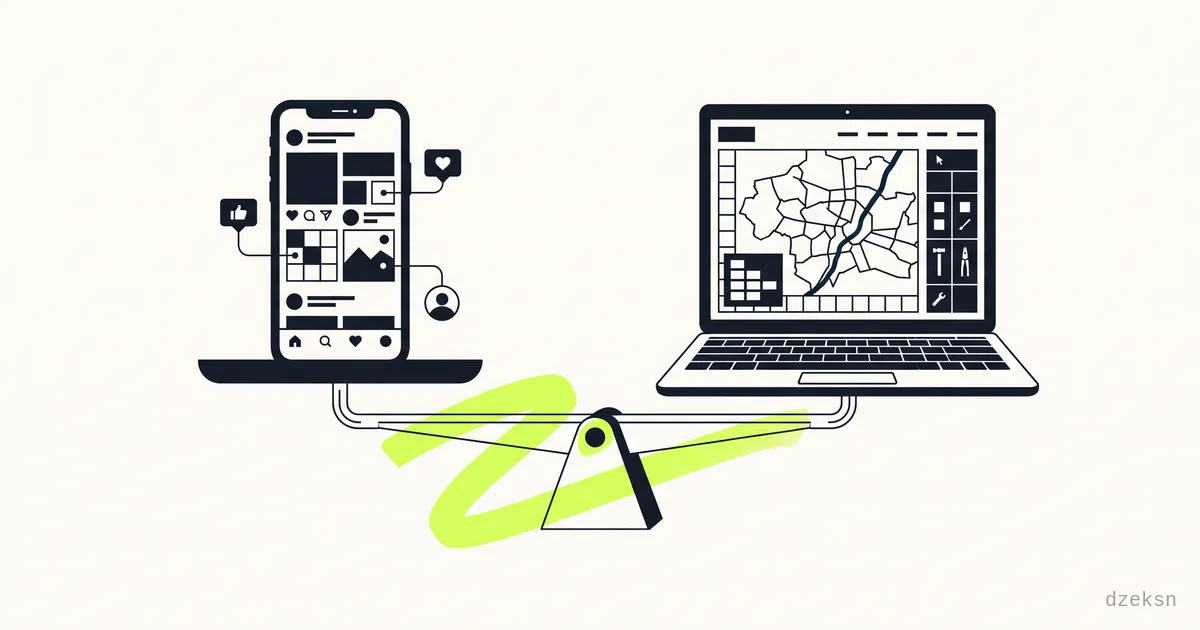
The honest answer up front: for a Munich business, social media alone is not enough. A well-kept channel brings you visibility, recognition and a community — but the paying customers who are looking for a service provider near them right now don't land in your feed. They land on Google and in map search. And your business only shows up there if it has a website of its own.
Social media and your own website are therefore not alternatives you have to choose between. They do two different jobs: the feed sparks attention, the website captures concrete demand. Anyone in Munich relying solely on social networks is giving away precisely the inquiries with the clearest intent to buy.
Why this difference is so pronounced in the Munich market in particular is laid out below.
What Social Media Actually Delivers — and Where It Stops
Let's start fair: an active social channel is valuable. It shows your work, gives your business a face, keeps regulars engaged and can reach new people through shares and recommendations. For visually driven businesses — café, beauty, fashion, tattoo, photography — it is a genuine channel for first attention.
What a feed structurally cannot do, however, is serve targeted demand. Social networks are discovery and entertainment media. People scroll there to pass the time, not to search for "tax advisor Munich West" or "electrician in Sendling". Exactly that high-intent search — someone has a concrete problem and wants it solved now — happens on Google and in the map view. The feed is window shopping; search is the walk to the till.
There's more: on a platform, only the people an algorithm chooses to serve your posts to will ever see them. You rarely reach all your followers, and anyone who doesn't know you yet won't see you at all — unless you pay for ads. When paid reach makes sense, and when a better website is the smarter investment, is covered in what does Google advertising cost in Munich?.
Why Munich's Buying Customers End Up on Google, Not in a Feed
Here the local angle gets concrete — and it is not decoration. Munich search behaviour plays into the hands of the owned website, for three reasons.
Munich is a city of neighbourhoods. Hardly any other German city has district identities as pronounced as Schwabing, Haidhausen, the Glockenbachviertel, Sendling, Giesing, Bogenhausen, the Maxvorstadt or Pasing. That feeds directly into search behaviour: people don't search for "hairdresser", they search for "hairdresser Haidhausen" or "beauty studio Glockenbachviertel". A social profile practically never ranks for such hyperlocal searches. A website with clean service and district pages does — it is visible at exactly the moment someone searches with a postcode in mind.
The surrounding region searches into the city. The Munich metropolitan area is huge. Customers from Dachau, Freising, Erding, Fürstenfeldbruck or the Starnberg district commute into the city, work there and look for providers all across the region. That demand runs through search, not through a friends-and-family feed — a business gets found by someone who didn't know it before. Social reach follows your existing network; local search follows concrete need. If your business itself sits in the surrounding area but wants customers from the city, the website is the only lever anyway — more on that in trade portal or your own website.
Competition is dense, purchasing power is high — and both reward findability. Munich is one of the most competitive markets in the country. Prime locations are expensive; many strong businesses sit on side streets or in the surrounding area and cannot rely on walk-in customers. At the same time, Munich's affluent customers research before deciding: they check reviews, services, the Impressum — the legal notice German websites are required to carry — and how to reach you. That trust check happens on a website, not in a feed full of stories. If you can't be found and verified there, you drop out of the shortlist — however good your actual work is.
Borrowed Reach vs. a Foundation of Your Own
There is another difference that often gets overlooked: who actually owns your visibility?
On a social platform, your followers are on loan. The operator decides how many of your posts get shown, changes the rules without warning, and can suspend an account if in doubt. If that happens, your entire reach is gone overnight — and with it, your line to your customers. You are building on rented ground.
A website belongs to you. Domain, content, findability — that is your property and your asset, independent of a platform's whims. You decide what it says, and nobody can lock you out. For a business that wants a plannable, long-term flow of inquiries, that difference is decisive.
And your own website is where the newer channels dock on as well: voice assistants and AI answer services draw on structured, machine-readable websites for local recommendations — not on your feed. Why that matters more and more for Munich businesses is covered in why AI search doesn't recommend my business.
When Social Alone Almost Works — and When It Doesn't at All
Honesty cuts both ways: there are cases where a strong social channel carries far. A street food stand, a pop-up, a niche label that lives off visual content and whose customers are on the platform anyway — here social brings genuine first contacts. But even these businesses need a website as the home base for opening hours, location, booking, and the simple question "is this a real, legitimate business?".
Clearly too little, on the other hand, is social for most local service providers: trades, law firms, medical practices, tax advisory, cleaning, building services. Almost no demand originates in the feed here — it originates the moment someone has a problem and searches for it. A trades business that posts diligently for months but can't be found for "emergency plumber Munich" wins exactly none of those jobs.
The Best Combination: Website as Foundation, Social as Amplifier
So the right question is not "social or website" but in which order. The foundation is your own website — findable for local searches, verifiable, in your possession. Social sits on top as the amplifier: the feed sparks attention and shows personality, the website converts that attention into calls, appointment requests and jobs. A post that piques curiosity links to the page that picks the prospect up and leads them to an inquiry.
That way both channels work together instead of against each other: social brings reach, the website brings results. And the website is the only one of the two that nobody can take away from you.
What This Looks Like in Practice
That a well-built, locally optimised website brings real inquiries is not an empty promise. A Munich commercial cleaning company appears with rich results in Google search and receives genuine customer inquiries through it — via search, not via a feed. A decluttering and house clearance business covers Munich and the entire surrounding area with more than 75 individual location pages and thus gets found at exactly the moment someone in its patch has a need.
What this can look like for different industries is on display in the showroom — with real projects and clearly labelled design demonstrations, from a hair salon in Haidhausen to a law firm. If you are weighing up whether your Munich business needs a foundation of its own alongside its social channel, that is the best starting point for a no-obligation conversation. What such a website realistically costs and how it comes together is summarised in having a website built in Munich.
Frequently Asked Questions
Is a free Google Business Profile enough instead of a website?
A well-maintained business profile in map and search results is important and should absolutely not be missing — but it does not replace a website. The profile shows basic details and reviews, yet it barely ranks for specific service-plus-district searches and offers no room to build trust or explain your offer fully. They work best together: profile plus your own website, each pointing to the other.
I already have lots of followers — does a website still add anything?
Yes, and especially then. Lots of followers are attention you have not yet converted into inquiries. A website is where an interested viewer becomes a customer — with a clearly described service, trust signals and a simple path to an appointment request. It is what lets you actually leverage the reach you already have.
For which Munich industries is social more important, and for which the website?
Visual, discovery-driven businesses — food and drink, beauty, fashion, creative work — draw genuine first contacts from social but need the website as their credible home base. Demand-driven service providers such as trades, law firms, practices or building services live almost entirely off local search; for them the website is the foundation and social is at best a garnish.
What happens to my visibility if my social account gets suspended?
Then it is gone in an instant — including your line to your followers. Reach on a platform is borrowed; the operator makes the rules. A website of your own belongs to you and stays findable no matter what happens on any platform. That is exactly why the website should be the base, not the interchangeable channel.
Can I embed my social media content on the website?
Yes. Recent posts, reference photos or a feed can be shown on the website in a privacy-compliant way, so that both channels reinforce each other. The site stays lively without your findability depending on the platform.