Modernizing your website: what it costs — and why your competitors' outdated sites are your opportunity
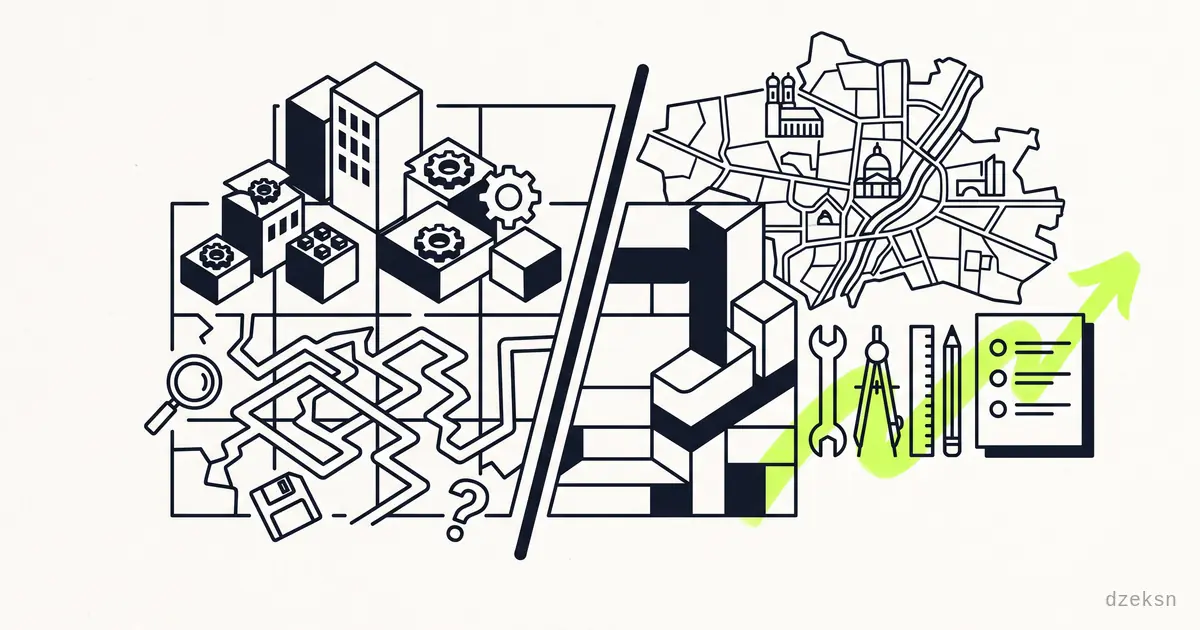
Modernizing an outdated website costs anywhere from a few hundred euros for a targeted refresh up to the mid — or, for large projects, upper — four-figure range for a complete rebuild with a new structure, new copy, and local findability. The price does not hinge on the new look, but on how much beneath the surface no longer works.
That is the short answer. The more important question is: does your site even need the full overhaul? Before you request a quote, you should know within five minutes how badly your site is really doing. That is exactly what this article is for — with a self-check you can run without any technical knowledge, and an explanation of why modernizing pays off faster for businesses in Munich's surrounding region than in the city itself.
The 4-point self-check: how old is your site really?
Open your website and go through these four points. Each one helps decide whether a refresh is enough or a rebuild is due — and with it, the cost.
1. Mobile: does the site work on a phone?
Take your smartphone and open your site. Do you have to zoom to read? Does the text spill over the edge of the screen? Are buttons so small you can barely hit them with your thumb? Then your site is not mobile-friendly — and today, that is the most expensive omission of all. The majority of local searches happen on phones. A site that stumbles there loses the prospect within seconds, no matter how good your work is. If mobile usability is missing, a refresh rarely suffices: that usually means a structural rebuild.
2. Load time: how long until everything is there?
Count how long your homepage takes to fully appear. Anything beyond two or three seconds is a problem. The most common cause is huge, uncompressed images and old, bloated code. If you want more precision, you can use Google's free speed analysis tool — just enter your address and you get a score. Slow load times cost you twice: visitors bounce, and Google downgrades the site. Pure speed problems can often be fixed cheaply if the foundation is otherwise sound.
3. SSL: does the address bar say "Not secure"?
Look at your browser's address bar. If the address starts with "https" and shows a small padlock — good. If it says "Not secure" or shows a warning, your site lacks encryption (the SSL certificate). For customers, that is an instant breach of trust, especially when a contact form is involved. Retrofitting this alone usually takes little effort — but it is a sure sign that the site has gone unmaintained for a long time.
4. Impressum & privacy policy: are the mandatory pages up to date?
Scroll all the way down. Is there an Impressum — the site notice with operator and contact details that German law requires on business websites — and a Datenschutzerklärung, the privacy policy? Are the details still correct — or does an old company name, a wrong address, or nothing at all sit there? Older sites often have outdated or missing mandatory pages, and that is more than a cosmetic flaw: a faulty Impressum or an outdated privacy policy can become a legal risk. If in doubt, verify the exact requirements with legal counsel or the responsible authority — this article is no substitute for legal advice. For the cost question, the rule is: the mandatory pages should be rebuilt cleanly in any modernization anyway.
Your result: one or two weak spots can often be repaired in a targeted, inexpensive way. If you fail three or four points, a genuine rebuild is usually more economical than endlessly patching a site whose foundation no longer holds. How the choice between refresh and rebuild plays out in the price is covered in detail in having your website rebuilt: costs & warning signs.
Why outdated competitors in the surrounding region are your biggest opportunity
Now for the part most people miss. In Munich itself, competitive pressure long ago forced many businesses to modernize their sites — in almost every trade, a row of fresh, fast websites now sits side by side. In the surrounding region, things are different.
In districts like Dachau, Erding, or Fürstenfeldbruck, the outdated company website is the rule rather than the exception. Many established trade and service businesses had their site built ten or more years ago and have not touched it since. Local competitive pressure was simply never high enough to change that. The result: anyone searching today for "your trade + your town" in the surrounding region often lands on a row of sites that do not work on a phone, load slowly, and look like relics.
For you, that is a rare opportunity. You do not need the best website in the region — you just need one that works today. A mobile-friendly, fast, properly findable site sets you apart instantly in a sleepy field, without requiring a Munich agency budget. That is exactly why modernizing pays off faster in the surrounding region: the gap to the competition can be closed with comparatively little investment.
There is a second dynamic in the region on top: businesses in the commuter belt almost always serve two markets — local customers, and the overflow from Munich, where people cannot find an available provider in the expensive city. A modernized site can capture both. How a business outside the city deliberately wins Munich customers through Google is covered in based in the region, customers from Munich; for the district of Dachau, web design in Dachau looks at the local situation.
What "modernizing" concretely means for the cost
The price follows what you actually tackle:
- Refreshing the look only — colours, typography, and images are renewed; structure and technology stay. The cheapest route if the site is technically sound and merely "looks old".
- Retrofitting the technology — mobile usability, load time, encryption, up-to-date mandatory pages. This is the classic core of a modernization, and the point where the real question is decided for most businesses.
- A complete rebuild — new structure, new copy, clean technology from the ground up. Necessary when several self-check points fail and the old system is no longer maintainable.
- Building out findability as well — from "technically clean" to dedicated town-plus-service pages for the surrounding region. This drives the price up, but in the region it is often the item with the greatest return.
At every level, the biggest cost drivers are new, unique copy and your own photos instead of stock material — that is where most of the future ranking is created. How a web designer's hourly and project rates in the Munich area break down is explained in what a web designer in Munich costs.
One point belongs in every modernization plan: a site that has built up trust with Google over years must not lose its rankings during the rebuild — with clean redirects, the visibility is preserved.
What a modernized, findable site looks like
You see the difference most honestly in finished work. For a commercial cleaning company based in the Dachau area, a website was built that stands out in Google search with enhanced results (rich results) and brings the business genuine enquiries — an ongoing client project from exactly the kind of location this article is about. For a decluttering and house clearance business, a site was built with more than 75 individual location pages for Munich and the surrounding region, where no page reads like a copy of another.
These and other examples — from skilled trades to a law firm, alongside clearly labelled design demos — are in the showroom. Every site is live and clickable; test them exactly the way you just tested your own: click through, load them on your phone, look critically.
If your self-check shows action is needed, briefly describe your site's condition and your goal. An honest assessment of whether a refresh is enough or a rebuild is the more economical route will save you from investing in the wrong direction.
Frequently Asked Questions
What does it cost to modernize an outdated website?
The range runs from a few hundred euros for a pure visual refresh up to the mid or upper four-figure range for a complete rebuild with new copy and local findability. What matters is not the look, but how much of the technology beneath the surface needs replacing — which is exactly what the self-check shows you.
Is a refresh enough, or do I need a complete rebuild?
Rule of thumb from the self-check: if only one or two points fail, targeted, inexpensive repairs are often possible. If three or four fail — above all mobile usability — a rebuild is usually cheaper than perpetual patching.
How do I check for myself whether my site is outdated?
Four quick tests: open the site on your phone (do you have to zoom?), time how long it takes to load, look at the address bar (does it say "Not secure"?), and scroll to the Impressum (are the details current?). These four points alone tell you how urgent a modernization is.
Is modernizing even worth it outside the city?
Especially there. Because many businesses in districts like Dachau, Erding, or Fürstenfeldbruck have outdated sites, a working, fast website sets you apart from the competition with modest investment — and the visibility then belongs to you, with no ongoing advertising costs.
Will I lose my Google rankings when modernizing?
Only through a sloppy rebuild. With correct redirects from old to new addresses and by carrying over well-ranking content, visibility is preserved or improves. That is why findability should be part of the plan from the start.