Rent or Buy a Website? The Honest Math for Small Businesses
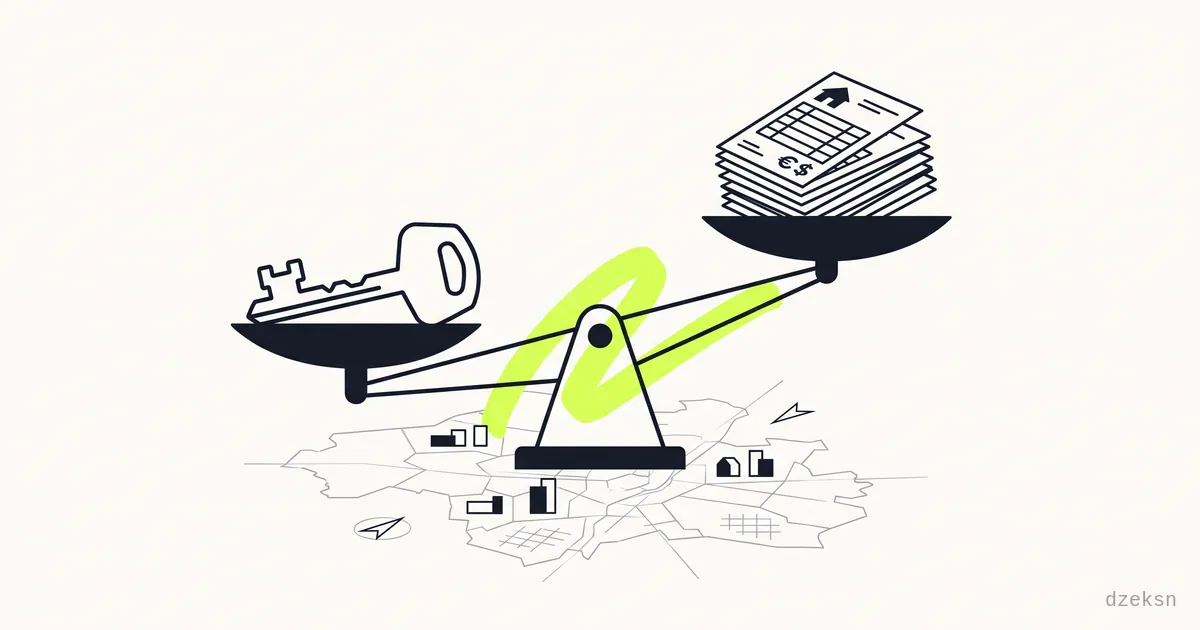
"Your website from 49 euros a month — no upfront investment." Offers like this land in many business owners' inboxes regularly. The rental model sounds tempting: no big amount at the start, everything included, no effort. On the other side stands the classic purchase: invest once, and afterwards the website is yours.
The short answer up front: for the vast majority of small and medium-sized businesses, buying is the economically and strategically better decision. Not because rental models are inherently dubious — but because with renting you pay permanently without ever owning anything. After five years of rent you have often spent more than a purchase would have cost, yet stand there empty-handed when you cancel.
Why that is, we calculate transparently in this article — and give you a checklist that lets you assess any offer in five minutes.
The rental model: what you actually get
With the rental model (often called a "website subscription" or "website as a service"), the agency builds your website and you pay a monthly fee for as long as the site is online. Hosting, minor changes and support are usually included.
The advantages are real:
- Low entry — no four-figure upfront investment
- Predictable monthly costs
- Technology and maintenance are the agency's job
The flip side rarely appears in the offer:
- The website is never yours. Design, code, often even the content remain the agency's property.
- Cancelling usually means: the site goes offline. You start from zero — after years of paying.
- Dependency: price increases, reduced services or the agency going out of business hit you directly.
- If the domain runs through the agency, in the worst case you also lose your web address and your Google rankings.
Important: a rental contract is not automatically dubious. What matters is what happens when you cancel — that is exactly what you should ask about before signing.
The purchase model: invest once, own permanently
With a purchase, you pay for the creation once. After that, design, code, content and domain belong to you completely. Running costs are limited to the domain (about 10 to 20 euros per year) and hosting — which for static websites can even be free, more on that in a moment; the full picture with all the options is in hosting a website for free.
- Full control: you decide who maintains the site, where it is hosted, what changes
- Minimal running costs after the initial investment
- No contract risk: nobody can "switch off" your site
- The website is an asset of your business, not a rental object
The honest downside is the entry price. What is realistic, we have broken down in the article What does a website cost for a small business?. Businesses in Bavaria should also look at the Digitalbonus Bayern, a Bavarian digitalization grant that can significantly lower the one-time investment.
The five-year math
The following figures are a sample calculation using typical market rates, not a price list. Your actual quotes may differ.
Option: rent
- 79 euros per month for a business website subscription
- 5 years × 12 months × 79 euros = 4,740 euros
- Ownership after 5 years: nothing. When you cancel, the site goes offline.
- After that: another 948 euros per year — permanently.
Option: buy
- One-time 3,500 euros for a comparable, individually built website
- Domain: 5 years × 15 euros = 75 euros
- Hosting: 0 euros (static website, self-hosted — see the case study below) or a few euros per month with classic hosting
- Total after 5 years: around 3,575 euros
- Ownership after 5 years: the entire website. From then on, only the domain costs remain.
Even in this example, buying comes out ahead after five years — and the gap widens by almost 1,000 euros every additional year. The real difference, though, is not the amount but the position: the buyer owns something, the renter owns nothing.
Case study: Maschinen Niedermeier — 100 percent ownership, zero monthly costs
What the purchase model looks like when followed through consistently is shown by our client Maschinen Niedermeier, a car and agricultural machinery repair shop in Scheyern near Pfaffenhofen, Bavaria.
We built the website and handed it over to the client completely:
- The website is 100 percent his — code, design, content, domain
- He hosts it himself, free of charge, on GitHub Pages, with his own domain
- Running costs: only the domain, no agency or rental fees whatsoever
- Technically it is a static website with complete SEO and a real workshop photo instead of a stock image
There is no dependency on us: if the client wanted to continue with another agency tomorrow, he could — all files are in his hands. That is exactly the standard you should measure every offer against. More on the industry in the article A website for your car repair shop.
When renting can still make sense
In fairness: there are situations in which a rental model is defensible.
- You are just starting out and simply have no budget for a one-time investment
- You only need the website temporarily (project, event, test phase)
- The contract includes a fair buyout option that lets you purchase the site later
In all other cases, what you are mainly paying for with rent is the agency's margin, year after year.
Checklist: the questions to ask before any signature
- Who owns the domain? It must be registered in your name — not the agency's. This is the single most important point of all.
- Who owns the code and design? Have the full transfer of rights confirmed to you in writing.
- Who owns the content? Texts and photos you paid for must belong to you — including handover of the files.
- What happens if you cancel? Do you receive the complete website as working files? Or does it go offline?
- Is there a minimum term, and how does the price develop? Watch out for automatic renewals and price adjustment clauses.
- Can you choose your host freely? A website that only runs on the agency's systems is effectively rented — no matter what the contract says.
- What does the buyout cost? If it is a rental model: is there a fixed purchase price at which you can take over later?
Ask these seven questions and you will sort out dubious offers within minutes. You can view completed purchase projects in our showroom; what a rebuild costs is covered in the article Having a website rebuilt — costs.
Frequently Asked Questions
Isn't a rented website better for taxes?
Rental payments are an immediately deductible expense, while a purchased website is depreciated over its useful life — both reduce your profit, just distributed differently over time. As a rule, the tax effect does not offset the rental model's cost disadvantage over five years. If in doubt, have your tax advisor run the numbers.
What happens to a rented website if the agency shuts down?
In the worst case, your website goes offline and you have no access to files or domain. That is exactly why the domain should always be registered in your name and the handover of the website files should be contractually agreed — regardless of the model.
Can I buy a rented website later?
Only if the contract provides a buyout option. Some agencies offer this, many do not. Ask for a fixed buyout price before signing — the answer says a lot about how serious the offer is.
Who maintains the purchased website once the agency is out?
You have the free choice: the same agency on an hourly basis, a different agency, or — for static websites with cleanly structured files — even yourself for small things like opening hours. Ownership does not mean you have to do everything yourself; it means you decide who does it.
Is the 3,500 euros in the example realistic?
As a ballpark for an individually built business website with several pages and SEO: yes. Depending on scope, region and ambition, the range extends well below and above that — a detailed breakdown is in the articles What does a website cost for a small business? and Web designer in Munich: costs.